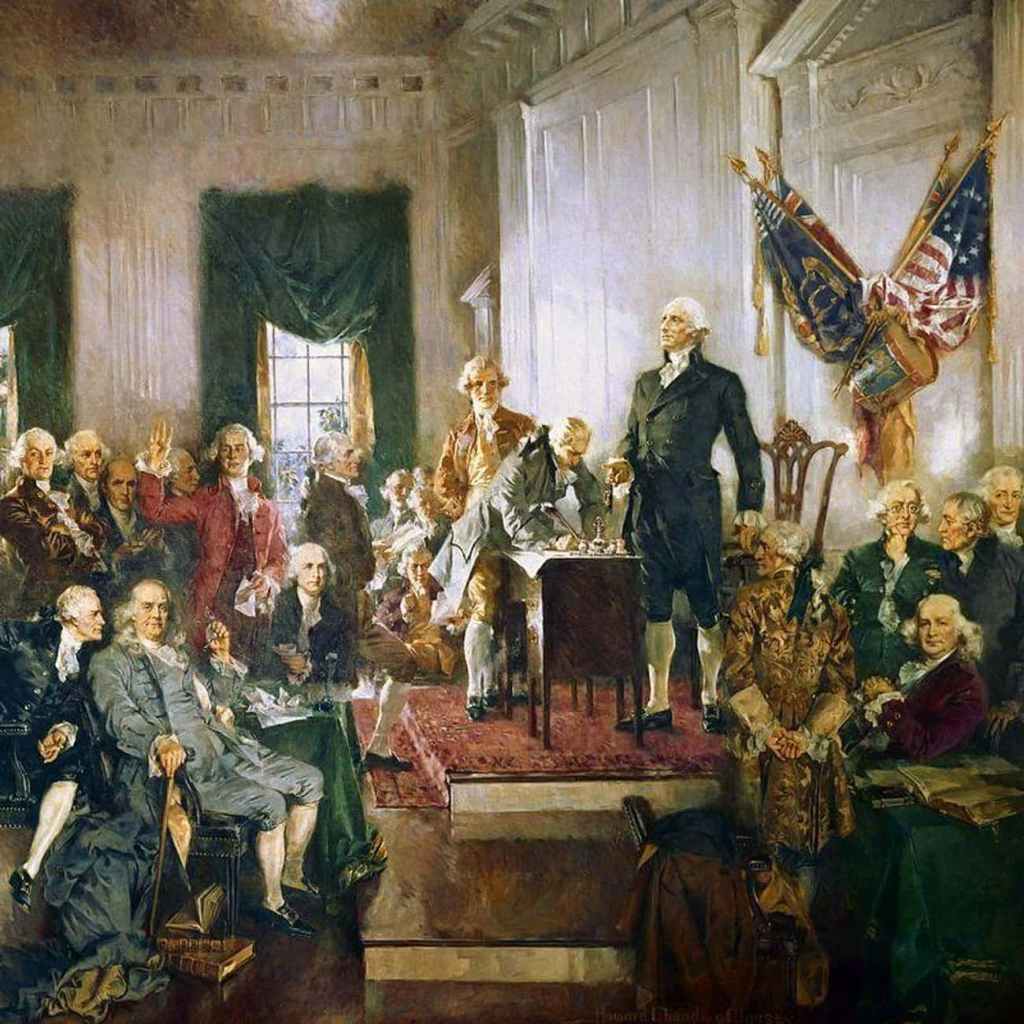
Reframing the Revolution
Every high school history class in America teaches students about the reasons for the Colonists’ revolt against the English crown, leading to the American Revolutionary War.
You probably know the story: no taxation without representation, throwing tea in the Boston harbor, Boston massacre, Bunker Hill, Yorktown, etc., leading to the birth of a new nation.
But, beneath the surface of this political narrative is an underlying esotericism underscoring the founding of what would become the economic and military powerhouse it is today.
Freemasons, students of esotericism, and conspiracy theorists alike are aware of the fact that many of the Founding Fathers of America were members of the Ancient Honorable Fraternity of Freemasons, namely: George Washington, Ben Franklin, Paul Revere, John Hancock, James Monroe, James Clinton, and Richard Stockton, among others. Freemasonry has its roots in Enlightenment-era thought and is steeped in symbolism, mystery traditions, and ritual architecture.
Outside of the influence of Freemasonry, some founders were either affiliated with or influenced (directly or indirectly) by other European esoteric philosophies, orders and societies, such as the Fraternity of the Rosy Cross (Fraternitas Rosae Crucis), Hermetic philosophy, the Invisible College, and the Royal Society: an institution that spearheaded the development of natural philosophy in England, which often straddled the line between science and metaphysical inquiry. Benjamin Franklin, for example, was a member of the Royal Society and is documented to have maintained correspondence with European alchemists and mystics.
Hermetic Thought and the Balance of Energies
In these esoteric orders, namely Hermeticism, the concept of the Principle of Gender is taught. This principle denotes that everything in existence has a masculine and feminine quality or energy to it. According to the Kybalion, the central text of Hermetic philosophy, spiritual mastery requires the harmonizing of the masculine and feminine energies within the self.
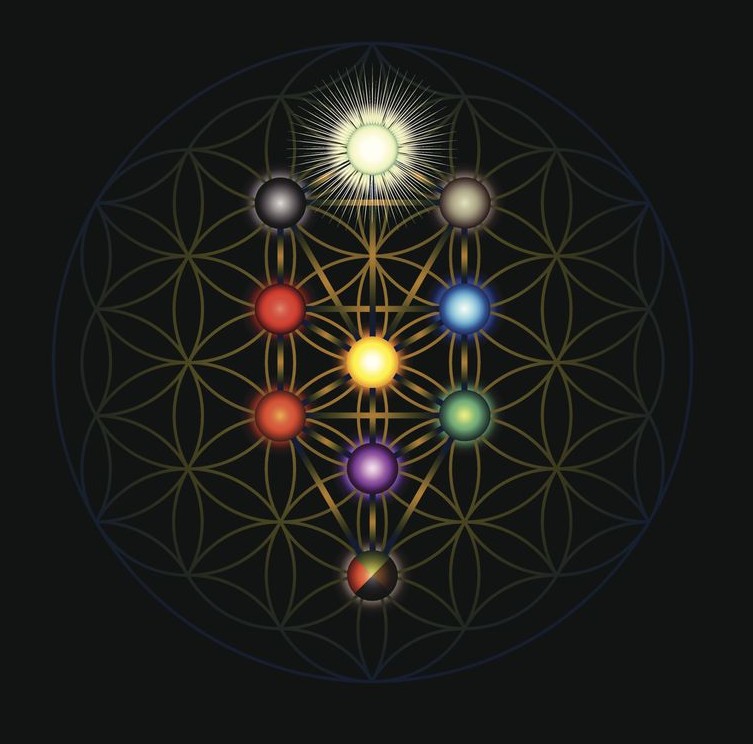
In this philosophical framework, the Deity is considered androgynous—a reconciliation of paradoxes, embodying both activity and passivity, intellect (logic) and intuition (emotion). This dualism forms the foundation of much of the Western Esoteric Tradition, including renditions of alchemy, Kabbalah, and later mystical Christianity (e.g., Gnosticism).
This idea is most famously visualized within the concept of the Kabbalistic Tree of Life. This three-pillar system states that the leftmost column, crowned by the sephirah Binah, is considered the feminine Pillar of Severity, while the rightmost pillar, crowned by the sephirah Chokmah, is considered the masculine Pillar of Justice. The pillar of Wisdom, or synthesis, lies between the two outside pillars and is known as “The Middle Path”.
In Masonic symbolism, this concept is echoed in the symbolism of the pillars said to guard the entrance to King Solomon’s Temple: Boaz, the feminine, passive pillar, and Jachin, the masculine, active pillar. Thus, King Solomon’s Temple becomes a symbol of the perfected human being or idealized society. One that lives in harmony with divine principles and embodies universal truths.
I deposit my theory for your speculation that this dualistic symbolism lives on in the iconography, geography, and Federal architecture of America.
Just as the Founding Fathers intended.
Columbia Rising: Goddess of the Republic
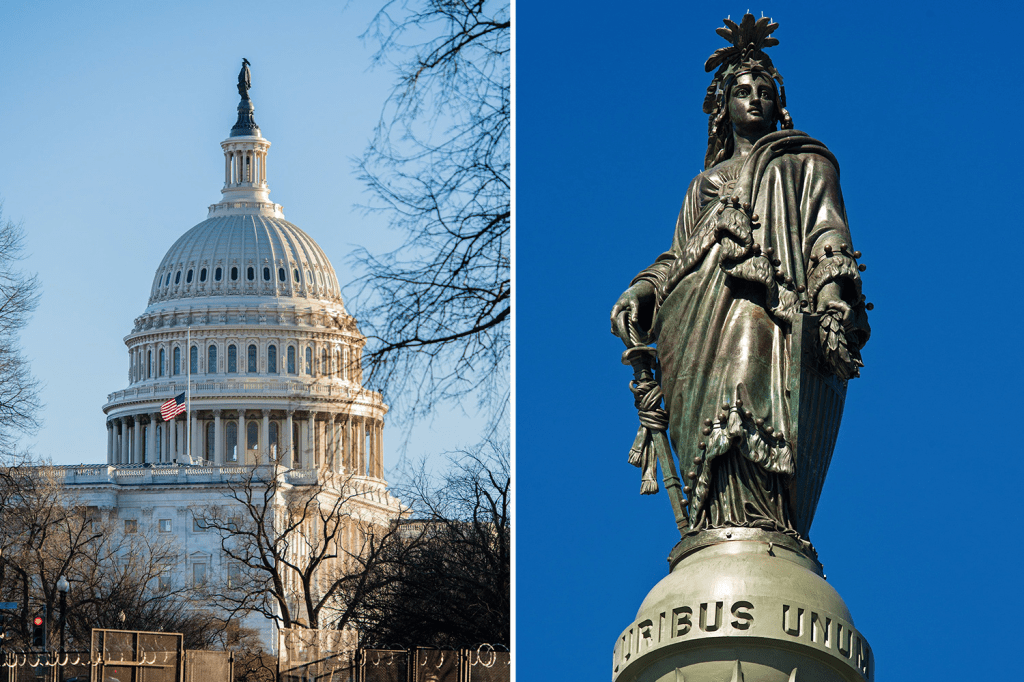
Though it may be a complete coincidence, I believe it was intentional that Columbia, an amalgamation of the goddesses Libertas (Liberty), Minerva (Wisdom), and Justitia (Justice), would have a District named after her that would serve as the capital city of the United States.
Through this naming, she was dubbed the Patron Goddess of America, and now rests atop the US Capitol building where Congress meets to create laws by which the citizens of America are to live.
Columbia entered the American consciousness in the early-to-mid 18th Century (1700’s). The first mention of her was poetic in nature, in London’s “Gentleman’s Magazine” in 1726 as a reference to the American colonies. After this, before the Revolutionary War, she emerged as a personification of liberty and resistance, thus representing the virtue, dignity, and struggle for independence in the American colonies.
Consider the fact that the District of the goddess Columbia rests in a geographic cradle formed by Virginia & Maryland.

Virgin-ia and Mary-land….. VIRGIN MARY.
Sure, Virginia was named in honor of Queen Elizabeth I of England (nicknamed the “Virgin Queen”), and Maryland named in honor of Queen Henrietta Maria (wife of King Charles I of England), but the “coincidence” of the alignment of these feminine archetypes cannot be lost on us.
This triune feminine symbolism (Columbia, Virgin, Mary) mimics the feminine Trinity concept prominent in Wicca: Maiden, Mother, Crone.
The Virgin is the maiden: untouched, untapped potential; Mary is the Mother for obvious reasons (or, at least obvious to those familiar with Christian symbolism); and Columbia is the Crone: no longer untapped potential in the form of the Virgin, nor the nurturing Mother figure in Mary, but a fully-realized Queen, full of Wisdom (Sophia, another feminine presence) carrying the symbols of liberty (torch), justice (sword), and balance (scales).
It is my belief that the presence of the Divine Feminine constructs were intentionally established to counter the masculine presence that dominated the founding of the United States.
The Lost Goddess Tradition
In prehistory (before the recording of events began to occur about 5000 years ago), archaeologists have discovered that systems of beliefs were centered around feminine deities who were venerated for the life-giving phenomena of childbirth. Since then, many major deities were made in the masculine image (Zeus, Anu, Marduk, Jupiter, Amun-Ra, Atum, Ptah, Baal, Yahweh, etc.), and it is my belief that the effort to re-elevate the feminine figure was materialized in the Enlightenment Era, of which the American Colonial era was on the tail end.
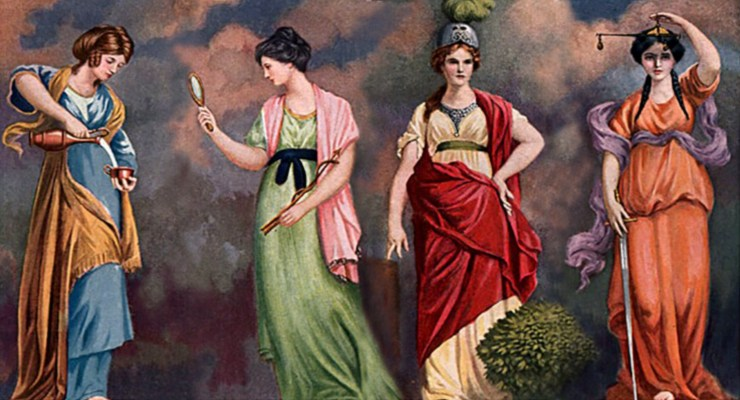
The feminine presence also persists in Freemasonry. The Four Cardinal Virtues (image from left to right: Temperance, Prudence (Wisdom), Fortitude (Courage), Justice) of Freemasonry are all pictured as feminine figures.
So are the Three Graces (image below, from bottom to top of ladder: Faith, Hope, Charity), which are all pictured as feminine angelic beings traveling along Jacob’s Ladder, emanating from and returning to the Blazing Star, the symbol of Deity.
These allegorical feminine figures are more than just artistic expressions of abstract concepts; they represent ideals that every Mason, and really every human being, should feel compelled to cultivate, offering a path toward moral and spiritual perfection through a harmonization of masculine action and feminine wisdom.

Now, at this point, you may be asking yourself: What use is any of this information to me, even if I believe it all?
Well, if one holds the understanding that the founding of America may have been influenced by symbolic and esoteric ideas, this newfound perspective could provide space for deeper engagement with one’s national identity. It begs the question: What kind of society were the Founders really trying to build, beyond just a legal or economic framework?
On a macro-cosmic (national) level, this newfound perspective could inspire more effective civic participation grounded in idealism, not just partisanship, to preserve balance, justice, and wisdom in governance at all levels.
Looking at America’s founding from this perspective doesn’t just give us a more colorful or alternative version of history; it invites us to reflect on what kind of society we were meant to build.
Maybe the Founding Fathers, influenced by esoteric ideas and ancient mystery traditions, were trying to do more than just create a new government absent of a monarch. Maybe they were planting the seeds of what they hoped to be a Utopian society: balancing logic and intuition, strength and compassion, flesh and spirit.
The figure of Columbia, nestled between Virgin-ia and Mary-land, isn’t just poetic. It’s a reminder that feminine wisdom, often overlooked in modern governance, was symbolically present from the beginning of America. And when we see monuments, statues, and structures of Washington, D.C. with new eyes, we start to realize: this country was founded with ideals that go beyond laws and borders.
For today’s society, this isn’t just interesting trivia. It’s a call to action to bring balance into our own lives, both internally through introspection (either through prayer, meditation, or other methods) and externally, through social discourse, and to revisit our values. To remember that liberty, justice, and wisdom aren’t just ideals for the courtroom or the Government to uphold, but for each of us to live out daily.
In the end, the esoteric layer of America’s story doesn’t compete with the historical one. I believe it enriches it. It reminds us that symbols matter, that deeper introspection and spiritual development is still valuable in this modern age, and that maybe, just maybe, the architecture of our nation was designed to awaken something within us.
 The Kabbalistic Craftsman
Leave a comment